






 Trap
 Continuous
Court of Cards
Archetype:
Knight
View:
4366
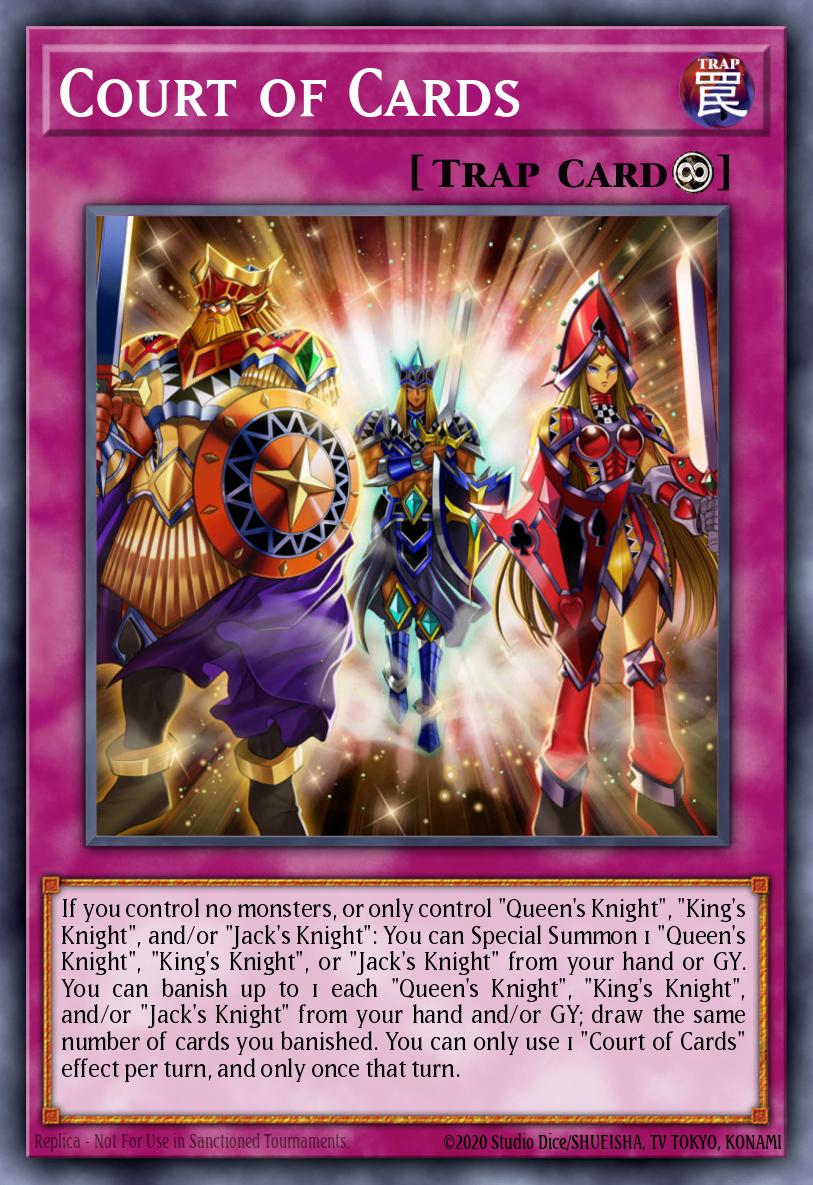
If you control no monsters, or only control "Queen's Knight", "King's Knight", and/or "Jack's Knight": You can Special Summon 1 "Queen's Knight", "King's Knight", or "Jack's Knight" from your hand or GY. You can banish up to 1 each "Queen's Knight", "King's Knight", and/or "Jack's Knight" from your hand and/or GY; draw the same number of cards you banished. You can only use 1 "Court of Cards" effect per turn, and only once that turn.
Court of Cards — Power Evaluation
Final Score: 51 ± 8 · Confidence: Medium
- Intrinsic: 48 · Deck: 53 · Meta: provisional
- Primary role: Recovery / Recursion · Secondary: Extender
Why it scores here
Court of Cards reliably converts its Knight network into a live body from hand or GY and draw for each Knight banished, which earns the Recovery/Recursion and resource points. It has no opponent interaction and is a trap, not a monster, so it earns nothing on material utility or interaction, and its ATK-free text is not inflated by the 69-deck sample. The 69-deck sample with near-universal Knight partners confirms it is practical in the Knight shell, but without combo data the conversion score stays text-only and moderate.
Axis scores
| Axis | Score | Evidence |
|---|---|---|
| Accessibility | 65 | Set from hand into the trap zone and reliant on Queen's, King's and Jack's Knight, which appear in 67 to 69 of 69 decks (observed; the card itself is a set trap that cannot activate the turn it is set, inferred). |
| Combo & Conversion | 45 | The text gives one Knight Special Summon plus a draw per banish, but no combo boards were supplied, so conversion is text-only (inferred). |
| Resource Economy | 70 | Banishing from hand is card-neutral while banishing from GY is a net gain, and each banish draws the same number, so value is repeatable once per turn (verified from text). |
| Effect & Interaction | 5 | No negation, removal or hand-trap reach; it provides no opponent interaction (verified from text). |
| Material Utility | 0 | A trap card is never material, so the score is zero by definition (verified from text). |
| Resilience & Flexibility | 45 | Face-up continuous trap in the spell/trap zone, exposed to backrow removal, with one use per turn shared across both effects (verified from text, inferred for interaction exposure). |
| Deck-Building Efficiency | 60 | One slot at 1 to 3 copies with average 1.41 copies per deck, no garnet, and a mild restriction to the Knight shell (observed from deck data). |
Calculation
Weight profile: 0.7 Recovery/Recursion + 0.3 Extender. Intrinsic ≈ 48, Deck ≈ 53, Meta = provisional. Modifiers: none. Final formula: 0.40*Intrinsic + 0.60*Deck
Strengths
- Two effects that convert Knights in hand and GY into a body and draw, repeatable once per turn
- Live in the Knight shell that appears in nearly every sampled deck
- No garnet cost and only one slot
Weaknesses
- No opponent interaction and no material value
- Depends on the Knight cards being present, so it is dead without them
- Set trap that cannot be used the turn it is set and is exposed to backrow removal
Counters / choke points
- Backrow removal or trap destruction, which can remove the set card before its turn (inferred)
Best use
Recovery/Recursion trap in Knight-based decks, used for summoning and drawing from Knights in hand or GY. Decks: Three Musketeers, Poker Knights, Tellarknight. Suggested copies: 1.
Evidence & gaps
- Verified: Card text: summon one Knight from hand or GY, banish up to one of each Knight from hand or GY to draw the same number, once per turn shared across effects; Trap card, Continuous, Knight archetype, legal in TCG, OCG, MasterDuel and DuelLinks
- Observed: Present in 69 of the sampled decks, with 37.7 percent in Three Musketeers and average 1.41 copies per deck; King's Knight, Queen's Knight and Jack's Knight appear in 100, 98.6 and 97.1 percent of those decks
- Inferred: A set Continuous trap cannot activate the turn it is set and is exposed to backrow removal; The 19 distinct archetypes are mostly null or Knight-adjacent, so portability is narrower than the raw count implies; Recovery/Recursion primary role with Extender secondary, from the text's GY summon and draw
- Data gaps: no combos supplied, so combo conversion is text-only inference no guides supplied no banlist token, assumed 3 copies (unlimited) no usage statistics (StatisticsCard), so archetype inclusion is inferred from the deck sample only no average starter count, so DeckResilience is judged from the archetype spread alone